Scripture: Isaiah 30:15–21
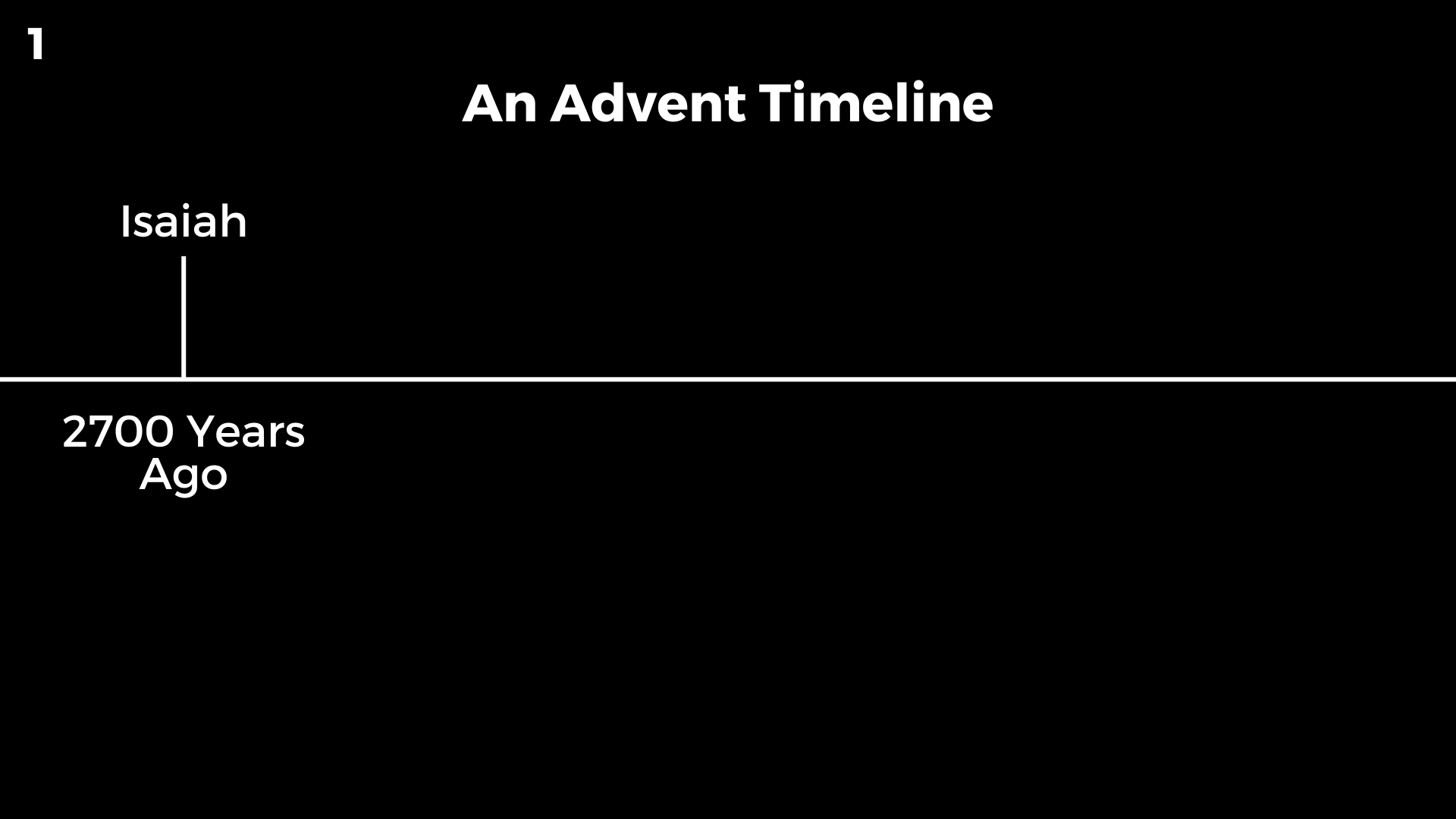
I want to talk this morning about an Advent timeline. The first plot on the line is around 2700 years ago, about 700 years before the birth of Jesus. The first 39 chapters of the book of Isaiah were probably written about this time, as the prophet lived and preached in Jerusalem, in the Southern Kingdom of Judah. During his lifetime, global powers were jockeying for position all around Judah, and before Isaiah’s prophetic career was complete, he would watch the Assyrian Empire invade and destroy their northern neighbors in Israel, fellow worshippers of God and fellow members of the extended family of Abraham. While Judah had their problems with their neighbors to the North, it must have been jarring to see them decimated and destroyed by the military might of Assyria.
In Isaiah’s time and place, words like hope and peace and joy and love felt at best naïve, at worst dangerously blind to the destruction on their doorstep. However, that is exactly the kind of language that Isaiah used to talk about God’s present and coming work on earth. As he had a front-row seat for the destruction of his geographical and theological neighbors, Isaiah found himself imagining and preaching about and actively hoping for a leader in his lifetime who might exist in his own lifetime, one who would lead the people in peace and humility. One who would not come with war and violence and destruction, but peaceful and child-like humility.

A second plot on the timeline comes 700 years later. When we read these words from the first 39 chapters of Isaiah, we cannot help but view them through the lens of Jesus. Christians immediately noticed how Isaiah anticipated the kind of leadership that Jesus would ultimately demonstrate. The book of Isaiah is quoted over and over again in the four Gospels. In fact, when we read the Old Testament during Advent, Isaiah is far and away the most represented book. Isaiah 2 talks about the day when we will “beat our swords into plowshares.” Isaiah 7 says “the virgin will conceive and bear a son” who will bring righteousness and peace. Isaiah 9.2 says “the people who walked in darkness have seen a great light.” Isaiah 9.6–7 celebrates “for unto us a child is born.” Isaiah 11 describes “a shoot will come from the stump of Jesse.” Handel’s Messiah would be a lot shorter without the book of Isaiah! When we think of the Advent timeline, we see how these moments are connected. The promise that Isaiah hoped for in his lifetime was ultimately met in the one who came in peace and not war, humility and not arrogance, love and not greed. When we read Isaiah, both of these moments on the timeline are important. It isn’t an either/or, but a both/and. These texts are not only speaking of a particular, historical reality, but also a universal, timeless reality that spoke to Isaiah’s time, and to Jesus’ time.
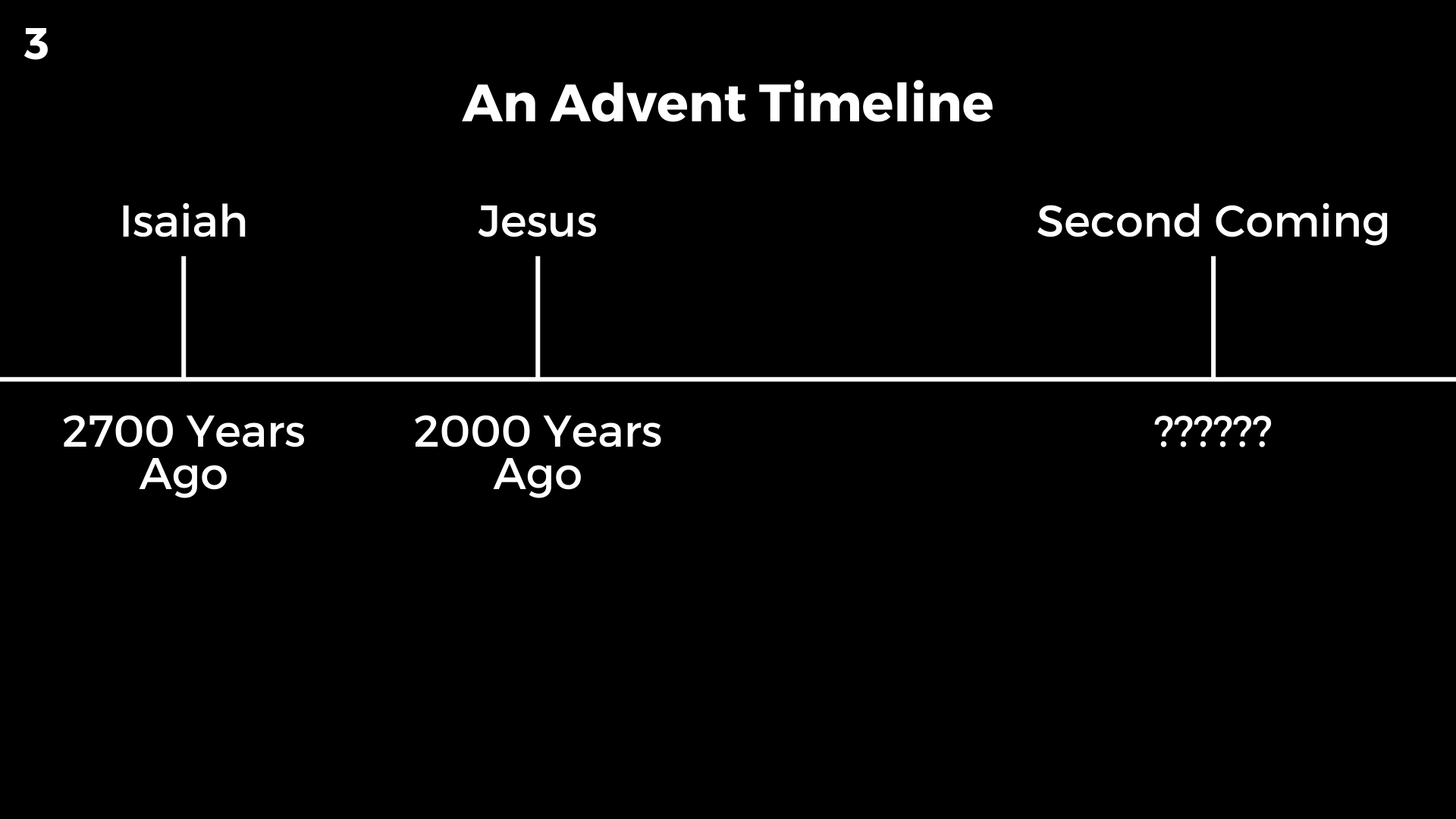
Or, really, it’s a both/and/and. Because there is a third point in time that is important to the timeline. In Advent we look back and celebrate what is sometimes called the “first coming” of God as a baby in Bethlehem. But we also look forward to this other future point, where Jesus will return in glory in what we often call a “second coming.” Like Isaiah, we can ultimately imagine Jesus’ return to set things right in the future. When we watch in real time the failures of Empire in our world, we can cry out like Isaiah in hope for something to change. We can yearn for peace. We can pray for love to reign as God commanded.
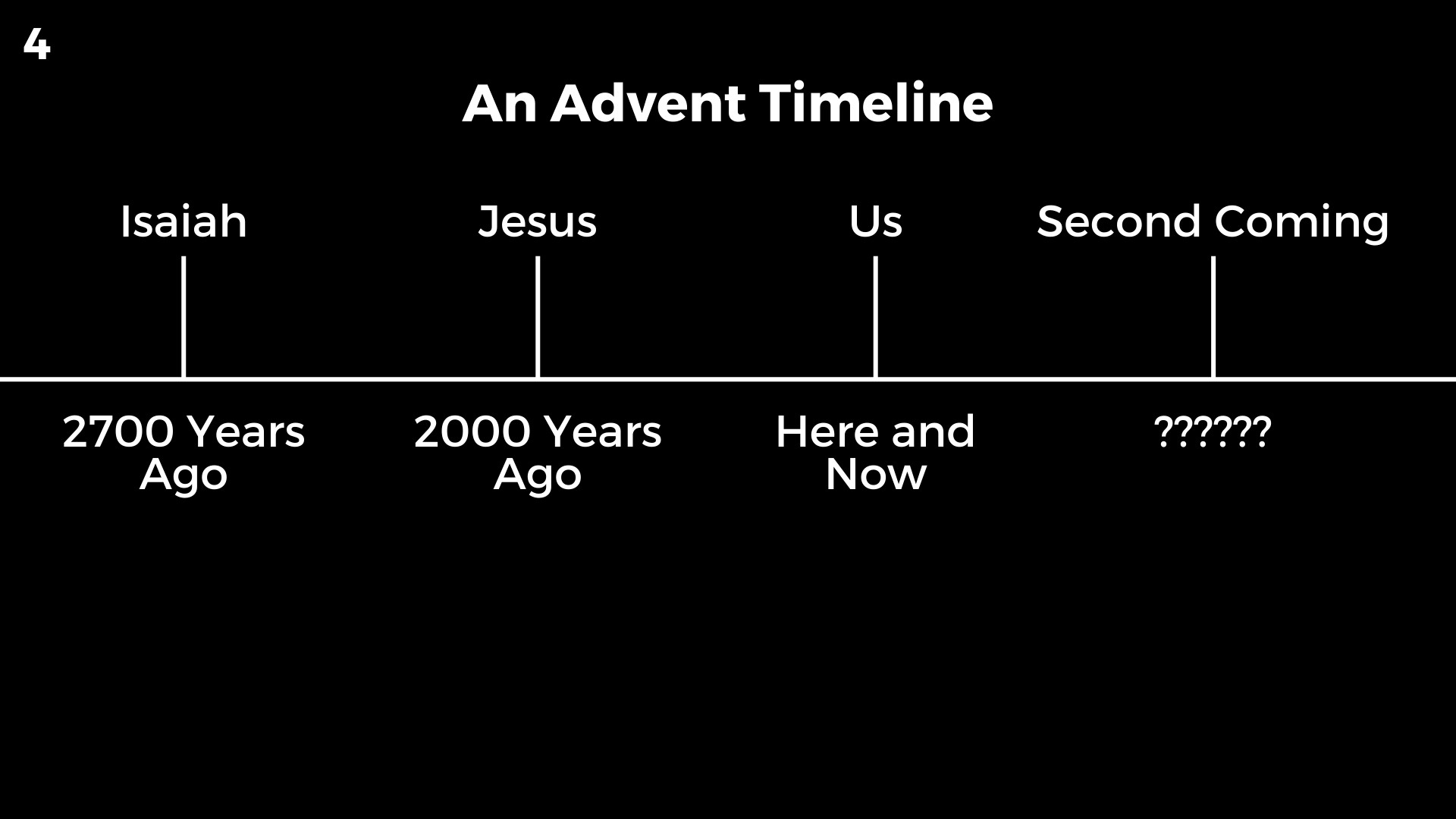
But let’s get crazy here. What if this Advent stuff were really a both/and/and/and? Not only do we look back 2,700 years ago to the way that Isaiah imagined the dismantling of Empire by the tools of peace and neighbor love. Not only do we look back 2,000 years ago to the way that Jesus embodied that peace and reframed for the world what God’s work looks like. Not only do we look forward to some unknown date and time, when God will set all things right in Christ’s triumphant return. But I think we can also talk about a fourth point on the timeline: here and now. And ask with open eyes and hopeful hearts how we might prepare and participate in that work, today. In our moment in time.
In a way, we have already been doing that for the last three months, right? Our series on Faith in Action has been all about how we can do that work that Isaiah anticipated…and Jesus exemplified…and God is ultimately moving toward completing. But, now our Advent series highlights a different kind of action. It is a shift from what we might call a faithful “hands and feet” action to what we might call a “heart and soul” action. A more contemplative, meditative action. Not inaction. Just a different action. A less active action? All Advent season long, we are looking at examples of how contemplative silence can be vital to a preparatory, participatory, anticipatory action. Throughout Scripture, we have tons of examples of how God’s people have learned how to listen, to act in this more meditative way. Mary who taught her sister Martha to listen at the feet of Jesus. Elijah who learned to hear the still, small voice in the midst of the wind and earthquake and fire. Simon Peter, who was always jumping out of boats and into fights, praying on a rooftop and receiving the revelation of what it means to love one’s neighbor.
Which brings us finally to Isaiah, Chapter 30. Most of the book is about a very active action. For those of you who think that faith and politics shouldn’t mix, don’t even open the book of Isaiah, because you’ll be sorely disappointed. Starting in Chapter One, and continuing throughout the book, he sounds like a political pundit who would be at home on Charlie Rose or Meet the Press. He was incredibly political in his writing, calling out failed foreign policy, insisting that his people could not count on political leaders to save them, even naming names of political leaders who were the least trustworthy. And he called out failed domestic policy, taking to task these leaders because they failed to care for the most vulnerable in their midst, hypocritically saying they believed in God while completely disobeying God’s command to care for the poor, the immigrant, the widow, and the orphan. But then, Isaiah the political pundit stops. And becomes Isaiah the pastor. Listen to these verses from the 30th Chapter:
Isaiah 30.15–21
15 For thus said the Lord God, the Holy One of Israel:
In returning and rest you shall be saved;
in quietness and in trust shall be your strength.
But you refused 16 and said,
‘No! We will flee upon horses’—
therefore you shall flee!
and, ‘We will ride upon swift steeds’—
therefore your pursuers shall be swift!
17 A thousand shall flee at the threat of one;
at the threat of five you shall flee
until you are left
like a flagstaff on the top of a mountain,
like a signal on a hill.
18 Therefore the Lord waits to be gracious to you;
therefore he will rise up to show mercy to you.
For the Lord is a God of justice;
blessed are all those who wait for him.
19 O people in Zion, inhabitants of Jerusalem, you shall weep no more. He will surely be gracious to you at the sound of your cry; when he hears it, he will answer you. 20 Though the Lord may give you the bread of adversity and the water of affliction, yet your Teacher will not hide himself any longer, but your eyes shall see your Teacher. 21 And when you turn to the right or when you turn to the left, your ears shall hear a word behind you, saying, “This is the way; walk in it.”
Isaiah Chapter 30 did not make it into Handel’s Messiah. It is not nearly as famous as those other Advent texts. But I think that Isaiah the Pastor’s words might help us with some important Advent work today: “In returning and rest you shall be saved; in quietness and in trust shall be your strength.” His words sound like the still, small voice whispered to Elijah. Or Jesus inviting Martha to see that Mary has chosen the one thing that matters. Or him telling Peter to get in line behind him and stop distracting his mission. “Rest.” “Quietness.” “Trust.” Words that connote a listening, waiting stance. Even that first word carries the same connotation. The word translated here as “returning” is connected to the Hebrew word for repentance. To repent in Biblical language carries the connotation of a literal turning or returning from the direction that you are going, and starting in a new direction. It is associated with returning to the Torah, away from the way they are currently going, and back to the commandments of God. Isaiah implores the people to stop, rest, reconsider, and recalibrate.
From there, Isaiah chides his people: “But you refused….” They still want to rely on military strength, but Isaiah implores them to see that those who trust in steeds and horses will be routed and those steeds will be what they retreat on the backs of, their tails tucked between their legs. Stop trusting in military might, Isaiah implores them…and us.
Scholar Trish Tull suggests that for Isaiah, these contemplative practices of repentance, and quietness, and rest, and trust, are at the same time communal and individual. Individual trust is tied to personal justice is tied to national justice is tied to shared repentance. She writes: “…quietism is envisioned as strengthened by the infrastructure of societal justice….Trusting God and holding steady may sound like naïve policy, until one examines the wisdom of trusting a nation who interests do not necessarily coincide with one’s own.”
In other words, when the world around us keeps offering oversimplified political answers to the problems of the world, we would do well to pause and ask, “Where is God in this?” And, “Where am I in this?” We turn again to the wisdom of Richard Foster and Kathryn Yanni, as they invite us to participate in the contemplative discipline of confession. A lot of us as Protestants feel uncomfortable confessing before others. We watch these movies where Catholics go into the confession booth and confess their sins and get assigned Hail Marys and maybe we secretly celebrate, “I’m glad we don’t have to do anything like that!” But Foster and Yanni suggest that confession is a historic and universal practice of all Christians, even if it looks different in different denominations.
Think about repentance and confession like this: perhaps you would look at the world around you and agree that it is not fully as it should be. Not the Kingdom of God on earth. The cultural response to this is the “blame game.” Pointing out whose fault it is and why those other people messed up. But here is where Foster and Yanni, and most other Christian contemplatives over the last 2,000 years, suggest that there is power in each of us asking how we participate in the brokenness of the world. How does our own sinfulness contribute to the world not being as it ought? Foster and Yanni describe what they call a “Diary of a Confession.” At the close of each day, for at least three days, they suggest writing down the ways that you have participated in the sinfulness of this world. There, in the silence between you and God, write down the things that you said or felt or did that day which carries some level of regret or the pull toward repentance.
The point of the exercise, they say, isn’t to pile on guilt or shame. We already have plenty of that. The point is, once we acknowledge our own guilt and shame, there is this other thing that happens. And Isaiah describes it: “Therefore the LORD waits to be gracious to you; therefore he will rise up to show mercy to you. For the LORD is a God of justice; blessed are all those who wait for him.” Forgiveness. Restoration. Receiving the mercy that Isaiah writes about. In our silent confession, there is grace.
In the final words of the passage, Isaiah moves into another familiar image in Scripture: that of a wise teacher, guiding us on an unknown path. This summer, on our trail running adventure in the Ozarks, we were in unfamiliar territory when we came upon a beautiful overlook. We admired the view for long enough that when we turned around, and saw multiple trail options in front of us, we weren’t sure which way to take. Of course, I knew the right way, and took off up a trail, but quickly it started to go up when we thought that it should go down. Sure enough, we pulled out the map, and I had led us…directly back onto the trail that we had just run on. Totally just backtracked up the hill that we had just run down. Thankfully, the map became the guide that we needed, and we were able to find the right way.
For Isaiah, when we find ourselves lost and turned around and not sure where to go next, we are wise to stop, rethink the situation, and ideally follow the way of the teacher. “This is the way; walk in it.” Don’t turn to the right or left, in the cultural and political quagmire that surrounds us. But in our own wilderness wanderings, when we find that the way seems unclear, Pastor Isaiah is inviting us once again to stop, rest, repent from the ways that we have gone astray, return to the map of God’s justice and righteousness, and listen with full attentiveness to the voice of the Teacher.
Leave a Reply