Scripture: Genesis 2:4b–22
A word of introduction about the reading this morning:
I’ll be reading the creation account from the second chapter of Genesis, which is, to state the obvious, not the first chapter of Genesis. The first chapter talks about the six days, and God said it was good, and the seventh day is the day of rest. But none of that is in the second chapter. And I want to say that out loud before we read, because I don’t want you trying to fit the two together, and wondering which of the six days this takes place on, because that isn’t really the point. In the same way that there are four different Gospels that tell the same story in four different ways, most scholars understand that there are two distinct narratives that say distinct but equally important things about God, God’s creation, and humanity’s role in that Creation.
So, instead of trying to fit that narrative into the other one, I invite you to see what makes this second chapter distinct. In fact, I am going to give you three words to consider as you listen. See if you see these themes in the text as I read: Identity. Mutuality. Relationality.
Genesis 2.4b–22
In the day that the Lord God made the earth and the heavens, 5 when no plant of the field was yet in the earth and no vegetation of the field had yet sprung up—for the Lord God had not caused it to rain upon the earth, and there was no one to till the ground, 6 but a stream would rise from the earth and water the whole face of the ground— 7 then the Lord God formed man from the dust of the ground and breathed into his nostrils the breath of life, and the man became a living being. 8 And the Lord God planted a garden in Eden, in the east, and there he put the man whom he had formed. 9 Out of the ground the Lord God made to grow every tree that is pleasant to the sight and good for food, the tree of life also in the midst of the garden, and the tree of the knowledge of good and evil.
10 A river flows out of Eden to water the garden, and from there it divides and becomes four branches. 11 The name of the first is Pishon; it is the one that flows around the whole land of Havilah, where there is gold, 12 and the gold of that land is good; bdellium and onyx stone are there. 13 The name of the second river is Gihon; it is the one that flows around the whole land of Cush. 14 The name of the third river is Tigris, which flows east of Assyria. And the fourth river is the Euphrates.
15 The Lord God took the man and put him in the garden of Eden to till it and keep it. 16 And the Lord God commanded the man, “You may freely eat of every tree of the garden, 17 but of the tree of the knowledge of good and evil you shall not eat, for in the day that you eat of it you shall die.”
18 Then the Lord God said, “It is not good that the man should be alone; I will make him a helper as his partner.” 19 So out of the ground the Lord God formed every animal of the field and every bird of the air and brought them to the man to see what he would call them, and whatever the man called every living creature, that was its name. 20 The man gave names to all cattle and to the birds of the air and to every animal of the field, but for the man there was not found a helper as his partner. 21 So the Lord God caused a deep sleep to fall upon the man, and he slept; then he took one of his ribs and closed up its place with flesh. 22 And the rib that the Lord God had taken from the man he made into a woman and brought her to the man.
This is the first week of school, and I know that we have a lot of teachers, paras, and other school staff in the congregation, so I want to spend a little time talking about a serious problem that I am sure that many of you will face this school year: missing glue sticks. How many times a week—a day!—do you find the top to a glue stick but no bottom? Or the bottom of a glue stick but no top? Do not fear, because a genius by the name of MissBThe3rd has solved this problem forever:
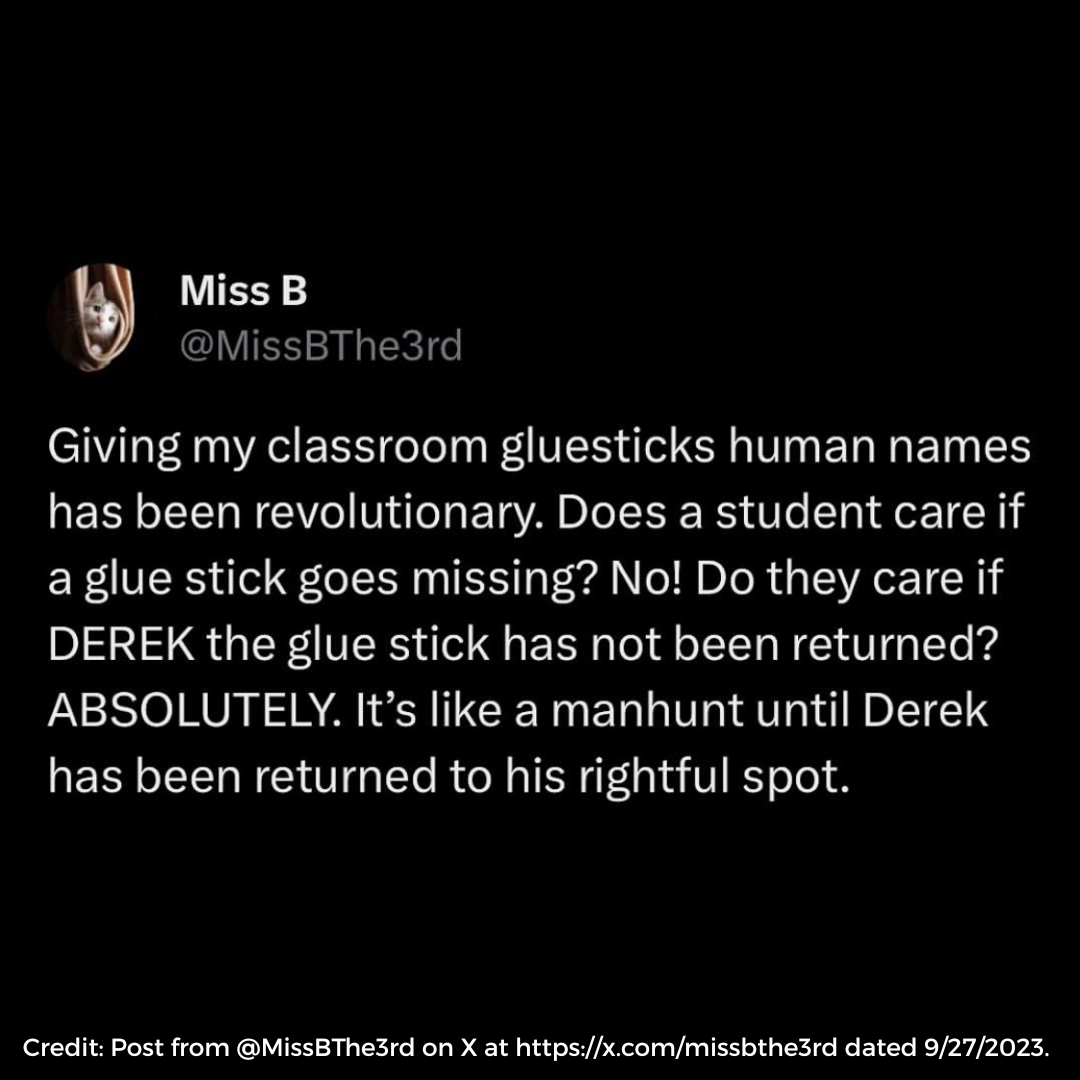
Miss B has figured out something incredibly important: Names matter. Connections matter. Relationships matter. Miss B gets it.
The author of Genesis 2 gets it, too. Names matter. Connections matter. Relationships matter. At the beginning of the narrative, God wants a garden. In fact, you could make the argument that that yearning is a part of the whole story of Scripture. The whole thing might as well be a Farmer’s Almanac! The Bible begins in Genesis with a garden. The Bible ends in Revelation with a garden. The way that God talks about the Promised Land as a place flowing with milk and honey…and how Jesus talks about seeds and trees and vineyards and farmers…makes it clear: God wants a garden. Of course, most of the Bible was written to an agricultural people, so this is what they knew. But I think that there is something more universal about God creating the world as a garden. Interwoven species, needing one another to survive. Order and structure and planning…but also flexibility and unpredictability. Rambling vines and chaotic plants and animals growing and buzzing and stepping on each other, all stretching toward the sun. This realization is key to understanding the book of Genesis, and I would suggest the whole Bible, to know that God wants a garden.
So, in Genesis, Chapter 2, God plants a garden. The language here for this garden process is very intimate and creative and relational. God wanted a garden, so God began with dirt. And God made water that gurgled up out of the dirt and made the dirt soft and fertile. And God put his hands into that moist, fertile dirt and formed ADAM. Human. A gardener. The text uses the same word in Hebrew that is used to describe a potter, forming clay into something beautiful. God the Potter formed ADAM the Gardener. And then, with the dirt and the water and the gardener formed and ready, God planted trees and plants. Flowers and fruit. Some were meant for food. Some were meant for beauty. Some were meant for both. All were meant to be cared for by the ADAM the Gardener. Humanity created from the garden, and for the garden. It is a story that is intimate and creative and relational.
Scholar Sandra Richter suggests that understanding this is crucial to understanding the rest of Scripture, and its overarching story of redemption. If we don’t get Genesis 1 and 2 right, we are likely to miss the point of the whole thing. Richter says it this way: “God’s ever-expanding universe was offered to his children such that they might always be captivated by its profound complexity, its fierce beauty, and its fragile balance. We were designed to love what God loves, and we were commissioned to seek the stars.”
So, according to Richter, and Genesis 2, we are all gardeners!
How many of you all are gardeners? You love getting your hands in the dirt? You love?
- Maybe you have a green thumb and you love getting your hands in dirt and planning and planting and watering and (maybe even) weeding…or maybe it doesn’t come easy to you and you have a hard time getting invasive species to take root in your plot of dirt! You are still a gardener!
- Maybe you have a vegetable garden, filled with tomatoes and peppers and cucumbers…or maybe you have a garden filled with beautiful flowers and lush and leafy plants. Either way, you are a gardener!
- Maybe your garden is huge, like my memories of my Granddaddy’s garden with rows of melons and beans and strawberries and corn…or maybe your garden is a small pot with herbs on your windowsill, or a couple of houseplants, or a low-maintenance succulent. You are still a gardener.
- Maybe you know what everything in your garden is called, and you know the Latin and common names and what variety it is…or maybe you are like me sometimes and you scratch your head and say, “well, that one is green” and you have to get your iNaturalist app out all the time to see if a plant is a weed or a thing that you actually want to be there. You are still a gardener.
- Like Richter says, it is in our God-created DNA to be gardeners, even if we can’t grow things like Lynne Beatty in our pollinator garden, or Wendy Wheeler on the [FBC] front stoop!
We are all meant to be gardeners. But pretty early, we began to fall away from that vocation. Oh, if only the story ended in Chapter 2. I am not going to get into the next chapter today, but Genesis 3 begins a story that goes downhill from there. Disobedience. Violence. Broken relationship. I am actually not going to spend much time in the details of that story, in part because it has the tendency to let us off the hook. When we get to blame Adam and Eve for the fallenness of the world, we can tend to believe that we would do better. When, in fact, we have done much worse. Theologians and naturalists agree.
Scholar and theologian Rowan Williams says it this way: “Our present ecological crisis, the biggest single practical threat to our human existence in the middle to long term, has, religious people would say, a great deal to do with our failure to think of the world as existing in relation to the mystery of God, not just as a huge warehouse of stuff to be used for our convenience.” Somewhere along the way, as early as Genesis 3 and as recently as this morning, we have forgotten that we are all gardeners. That we are all created to care for God’s garden. Williams pushes each and every one of us to ask whether or not we participate in a shared forgetfulness of our original calling to be gardeners. Is Genesis 3 our story, too?
E.O. Wilson, naturalist and writer, calls Christians to account for our participation in the destruction of the earth. Several years ago he wrote a book, written to a fictional Baptist pastor, asking why he had abandoned his call from the first chapters of Genesis. He decries things like species extinction, and a lack of biodiversity, and the abandonment of conservation efforts for industrial profit, and the rejection of science as somehow counter to our faith. We fail to understand Creation, thus we fail to care about Creation, thus we are engaging in activities that regularly dispose of Creation. And this is counter to Scripture, and to humanity’s best interest.
Disobedience. Violence. Broken relationship. Again, it is Richter who summarizes these thoughts beautifully: “Humanity was created and commanded to serve and to protect, yet humanity has instead ravaged the garden.” In other words, at the end of the day, we look at God’s glorious Creation…and we just see a glue stick. A thing for us to use until it is dried up.
But what if that glue stick was DEREK!?! MissBThe3rd is right. Names matter. Connections matter. Relationships matter. Genesis 2 has been trying to tell us this from the beginning! In fact, do you remember the three theme words that I told you before we even read the text?
IDENTITY. There is a reason why God tells ADAM to name the animals. Like Miss B discovered, when we move from commodity to relationship, things change. God knew that if ADAM looked around the Garden and just saw “Salad. Salad. Salad. Meat. Meat. Meat. Lumber. Lumber. Lumber.”…then humanity would never understand the value of each and every part of creation. But when ADAM named the creatures—and when we name and understand nature—it fundamentally changes the way that we see our fellow creatures. It’s what E.O. Wilson is asking us to understand. The Purple team of Earthworks discovers this over and over again, when we learn about trees and animals and plants and the ocean and stars. When we name these parts of our shared creation, we move from commodity to relationship. Fellow gardeners, I invite you today to remember our calling. Remember our first vocation. Remember that we were made for this.
MUTALITY. A second incredibly important concept in Genesis 2 is the connection from Gardener to Gardener. ADAM to ADAM. You may not be able to notice this in the English, but in the Hebrew, the first word used to describe humanity is more universal and non-gendered: ADAM. But then God realizes that a single human is not enough. We need fellow gardeners. So, God the Potter creates again and forms a partner gardener. In Hebrew, the words are “ish” and “ish-shaw.” Literally, one comes from the other, and they become partner gardeners together. In fact, the Hebrew word translated as “helper” is the same word that is used in the Psalms when the Psalmist proclaims that “God is my help and strength.” Partnership made in the image of God. Human is meant to partner with human, in the shared work of gardening. Again, moving from commodity to relationship. From possession to partner. All summer long, we have been exploring this relationship in our Summer of Peace. How we relate to one another matters, and that mutuality started in the Garden.
RELATIONALITY. Finally, a third incredibly important relationship here is that of the inhabitants of the Garden…to the Creator of the Garden. When the Bible talks about peace, it is most often talking about the concept of Shalom. Shalom refers to this idea that all of God’s creatures share in the vocation of worship of their creator. It changes the way we engage with creation when we understand that even the rocks cry out to worship God, and the trees clap their hands, and every chirp and grunt and howl is a holy song of worship. Again, it is Richter who describes shalom beautifully: “I am completely convinced that the redemption of all creation is the gospel. Therefore, creation care is not merely a message of social justice, a wise approach to life on this planet, or a political action item. It is instead a life posture that reflects the character of God and embodies…his plan.”
Last week, Kimberly and I visited a garden.
Technically, a thousand-acre collection of gardens, woodlands, meadows, ponds, and greenhouses. Longwood Gardens, in Pennsylvania, is a beautiful reminder of what God, gardener, and garden can do together. And the visit was this cool, Shalom-moment. There was identity, as we learned about different species and how they related to each other. There was mutuality, as we enjoyed the time with friends and they could share a place that they loved to experience. There was relationality, as we experienced echoes of the first garden in this example of God’s garden.


My prayer for you this week is that you might have a similar experience. May you know the peace of God’s shalom. May you experience the bounty of God’s good garden, maybe even with the work of your own gardener hands. And may you worship the creator in that place of peace.
Leave a Reply