Scripture: Isaiah 55:6–13
Something is wrong.
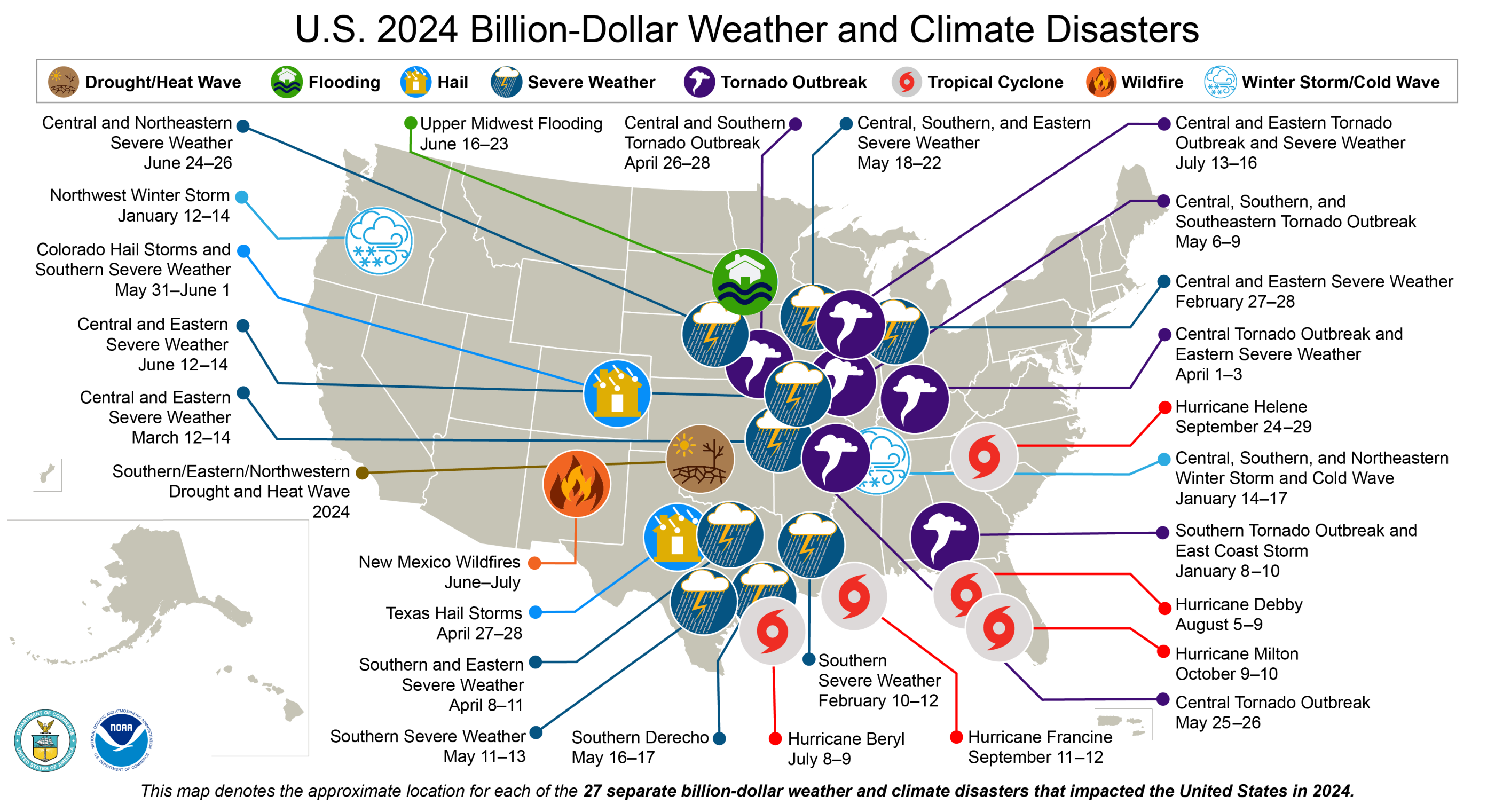
Above is a map representing each of the weather events in 2024 that resulted in costs over a billion dollars. Tornadoes and floods in the Midwest. Hurricanes from the Atlantic and the Gulf of Mexico. Wildfires out west. We glance at pictures online, or see video in the news, but a map like this puts it into perspective, how widespread these events have become.
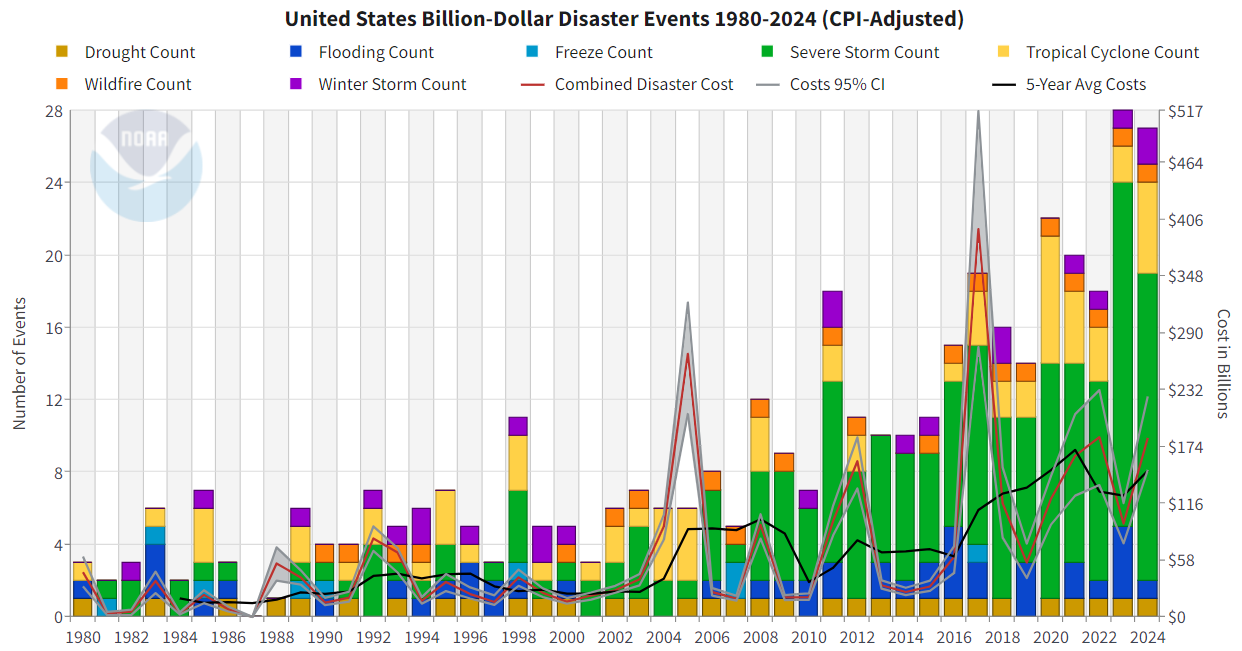
Case in point, above is a chart representing the number of these billion-dollar weather events since 1980. More and more and more, year after year after year. Of course, this has been adjusted for inflation, so that the dollar amounts are comparable. So when laid out like this, you can see a clear trend. In the first few years of the chart, the numbers of these events annually were 3, 2, and 3. In the last three years, they have been 18, 27, and 28.
People are noticing that something is wrong:
- Climate scientists have been warning us for years that these numbers will only get worse. Every year the average annual temperature gets higher, and the top seven highest annual temperatures on record have all been in the last decade.
- Meteorologists used to talk about natural disasters as if they were rare, unpredictable, and random, but now they acknowledge that the trend suggests this is the new normal.
- The US military has been highlighting for years certain hotspots that are likely to erupt in violence due to water shortage, predictable droughts, and other weather events.
- Farmers keep watching their irrigation budgets climbing as the aquifer underground shrinks.
- Insurance companies cannot keep making these payouts and stay afloat. Last spring, at a clergy conference, we got a report telling churches to expect insurance rates to keep climbing, or to even be dropped completely. I was at a meeting last week where church leaders reported that for each of the last two years, insurance rates have doubled…doubled for 2025, and they will double again for 2026.
People are noticing that something is wrong.
The Two-Way [Sermon Discussion Group] folks named this dynamic as soon as they read today’s text. God has created weather patterns in ways that are predictable and restorative. But because of the human impact on climate change, these patterns have been disrupted. They drew comparisons to Romans 8, where Paul notices that “creation groans” in light of human sinfulness. They called out our failed stewardship. We were called to care for the garden, and we have neglected that calling. And it has resulted in suffering for God’s children.
The Two-Way [Sermon Discussion Group] scholars also correctly named another dynamic in the text. Isaiah 55 is in the middle of a crisis moment for God’s people. They were in the middle of 300 years of Empire violence. First the Assyrians, and then the Babylonians, and then the Persians, all pursued this violent, colonial mindset that little Israel was caught up in. The Assyrians destroyed the northern kingdom of Israel. Then the Babylonians destroyed the southern kingdom of Judah, burned Jerusalem to the ground, and killed or exiled most of the ruling class. They were living through a crisis, in ways eerily similar to our current climate crisis.
I want take their observations and push even deeper in this connection. I would suggest that there are at least a handful of ways that humans respond to a crisis this significant. Some will deny that there is anything wrong. “Nothing to see here!” They stick their heads in the sand. They ignore the signs. This absolutely happened in this 300-year Empire crisis amongst the people of God. Some said that “we’ll stand up to Assyria” or “Babylon is our friend” or “Egypt will come to our rescue.” Deniers fear the crisis and so they ignore what is happening around them. You see the same thing today in the middle of our current climate crisis. They ignore the pretty clear evidence that something is wrong, and they re-brand facts as politics and do their best to stick their heads in the sand. Instead of looking at bigger trends, they say things like “it was cold in my neighborhood yesterday, so global warming must be a hoax!” Even when it’s their houses that are destroyed or their insurance that gets dropped, they deny. And I understand the inclination. I don’t want to beat up on deniers too much. There is something comforting and predictable about the status quo…if we pretend that nothing is wrong, then we feel better about it. Until they were led out in chains, watching their homes burn, the people of God said the same thing.
A second common response to crisis is despair. Some deny…others despair. “Woe is me. Woe are us. God hates us and there is nothing we CAN do about it.” Again, this happened in the Empire crisis to the people of God. Psalm 137 recounts this despair: “By the waters of Babylon, we wept. They told us to sing songs of our faith, but we threw our harps into the trees, for we could no longer sing the songs of faithfulness.” Despair. Of course, you see a similar response among some folks to the climate crisis. We can’t do anything about it, so let’s just complain. Or blame everyone else. Or “eat, drink, and be merry for tomorrow we might die.” Each of these responses actually has despair at its root: “There is nothing that I can do to respond to climate change, so who cares?”
When we see crisis, then and now, watch how many people choose one of these two options: deny or despair. But there is another way: the way of the prophet. Remember that when we talk about Biblical prophecy, it is not like Nostradamus, telling the future. It is really about naming the present reality: “truth-telling” more than “foretelling.” If there is a predictive quality to Biblical prophecy, it is usually because the prophet understands the present context so clearly, that they know how it will play out in the future. Isaiah, here, speaks into the context of deniers and despairers that there is another way. There is value in saying “we will not deny the pain around us, but neither will we succumb to hopeless despair. Instead, we will choose hope.”
Most scholars agree that Isaiah 55 comes from a moment in time in which the people of God are returning to Jerusalem after Exile. They have lived through the pain of Exile, and both the deniers and despairers have had their say. But into that crisis moment comes a different voice of what you might call “active hope” or “hopeful action.” Isaiah reminds the people that there is work to be done and that, in fact, God is already doing that work and inviting us to be a part. If deniers and despairers are seeking certainty, in their blind good news or their helpless bad news, Isaiah tells them that they can have certainty, in God!
These are some of hopeful actions of the way of the prophet. We reframe. We observe. We celebrate. We worship. It is the active hope that the prophet invited God’s people to then, and it is the way of the prophet into our creation crisis today.
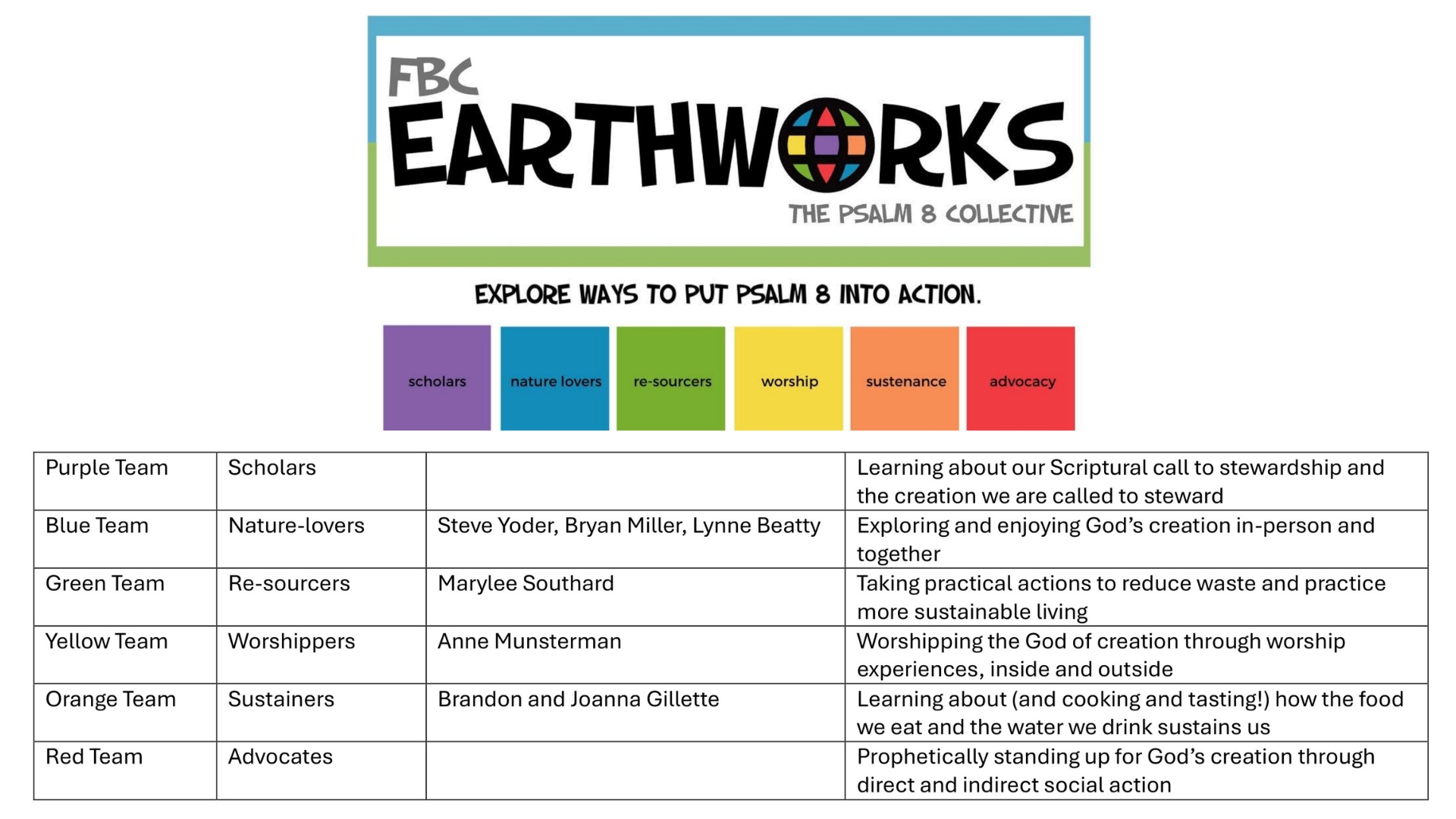
But here is the good news: you are already doing it! You are the mighty Baptist prophets of Lawrence, Kansas, and you have been faithful to that calling! This year, we celebrate five years of our commitment to Earthworks: The Psalm 8 Collective. This is more than just a calendar of things to keep us busy, for me to announce every Sunday. What we are doing is the same prophetic action that we see happening in Isaiah 55. This will be review for some of you, but perhaps at our anniversary year, it is a helpful reminder. In the context of a climate crisis, when some deny and others despair, you have chosen a third way!
Look at some of the ways that you have shared that prophetic voice with others:
- The Purple Team, the Scholars, who learns about our Scriptural call to stewardship and the creation we are called to steward.
- The Blue Team, the Nature-Lovers, who explores and enjoys God’s creation in person and together. They have been led by Steve Yoder, Bryan Miller, Lynne Beatty, and Jim Lord.
- The Green Team, the Re-Sourcers, takes practical actions to reduce waste and practice more sustainable living, led by Marylee Southard and her team.
- The Yellow Team worships the God of creation through worship experiences both inside and outside. Anne Munsterman leads that effort.
- The Orange Team, led by Brandon and Joanna Gillette, learns and teaches (and cooks and eats!) as a way to understand how the food we eat and the water that we drink sustains us.
- Finally, the Red Team stands up for God’s creation through direct and indirect social action.
- You’ll notice that a couple of these groups don’t have leaders right now. If you have an interest in helping to lead either the Purple or Red Teams, let me know!
Early after the creation of Earthworks, the pandemic began. It was a time of deep chaos and international crisis. It would have been easy to say “let’s start this whole initiative later, when things settle down.” But we did the opposite. We began advocating, and exploring, and learning, and stewarding, right in the middle of the mess. In the last five years, it has been a way to help define who we are, and others have noticed, finding themselves drawn to this prophetic word that we have shared with the world.
That first summer, we figured out a way to gather together safely, and took a trip together to climb Pikes Peak. And I still remember, standing on the summit, looking out over the Front Range, in a time when the world was in outright panic, and realized that God was still on God’s throne, and the Creator was still creating.
In these days, even as we look around and see all that is wrong with the world, let us join in the hope of those prophets who have gone before, and join the worshipful work to which we are called.
Leave a Reply