Scripture: John 1:6–9; 19–27
How many of you all have been in a cave before? There are a lot of caves in Kentucky and Indiana, around where I grew up, so I have been in several caves, and on several cave tours. When a guide walks a group into a cave, you can almost be guaranteed that there will be a moment in which they tell everyone to stop, and be totally silent, turn off all of their flashlights and lanterns. And there, in the darkest spot on the tour, you truly experience the darkness of the cave. It is more than a little disorienting. The longer the tour guide waits, the more disorienting—and even a little terrifying—that darkness becomes. Then, slowly, the tour guide turns on a small light and others join in, and you can hear people let out a little sigh of relief. There is something stifling about the dark.
The Gospel of John begins with this contrast. You may know that the beginning of John seems to be intentionally based on the beginning of Genesis. In Genesis, all was dark and chaotic, until God spoke and there was light. Likewise, John suggests that when the Logos, what we translate as the Word, appeared, it shined a light in the midst of the darkness. It is a beautiful and powerful image that has the potential to help us see Jesus, and the world, in new ways. And, as the Church has shown for the last 2,000 years, it has the potential for ironic and disastrous misinterpretation!
Some of it is in our language. Especially Europeans and European-Americans have a tragic history of equating white-ness with Christ-ness…suggesting subtly or even bluntly that those with dark-skinned bodies are somehow “less-than.” Of course, for most of us, it feels silly to imagine folks buying into such a racist and non-Biblical ideology. But for much of the history of the Church, and for a lot of people even today, this is still a deeply-held belief. And the discrimination that it births still costs lives. So, I think we need to acknowledge, especially on days like Epiphany Sunday, when we use our language to celebrate the light of Christ, defeating the darkness, we need to think about the unintended consequences of that language.
But there is another level to this misinterpretation of the first chapter of John. Author Parker Palmer writes about how we as Christians often run the risk of unintentionally projecting shadows more forcibly than the light. In his book Let Your Life Speak, he says it this way:
A…shadow inside many of us is the belief that the universe is a battleground, hostile to human interests. Notice how often we use images of warfare as we go about our work, especially in organizations. We talk about tactics and strategies, allies and enemies, wins and losses, “do or die.” If we fail to be fiercely competitive, the imagery suggests, we will surely lose, because the world we live in is essentially a vast combat zone. Unfortunately, life is full of self-fulfilling prophecies. The tragedy of this inner shadow, our fear of losing a fight, is that it helps create conditions where people feel compelled to live as if they were at war.
I think his analysis is spot on. In our assumption of thinking that we alone hold the light, we end up projecting more darkness and shadows. How many have seen the new Knives Out movie, Wake Up Dead Man? I just saw it this week, and you may know that the whodunnit movie series is about a famous detective, Benoit Blanc, who always shows up and solves the case and saves the day. The latest movie is a fascinating look at religion, and belief, and the Church, and its followers. And while I promise I won’t give away any plot points or ruin the mystery for you, I think I am safe in sharing a quote from one of the characters, which succinctly makes the same point as Parker Palmer: “You start fighting wolves, and before you know it, everyone you don’t understand is a wolf.” More darkness than light.
Thirdly, Palmer suggests another misinterpretation of this language of light and dark. In a related concept, he references what he calls “functional atheism.” There are a lot of Christians, he suggests, who talk about their faith in a sovereign God, but then act as if that God is completely helpless and useless! That if anything is going to happen, we have to do it! Functionally, Palmer says, it is as if we believe that God doesn’t even exist.
I think we see that in spades in our world. One of the things that frustrates me the most about political progressivism, especially Christian progressivism, is this humanistic idea that the whole thing depends on us! We have to save the world. We have to transform it. We and our politics and our structures and our solutions are the saviors of history. Meanwhile, one of the things that frustrates me the most about political conservatism is this humanistic idea that the whole thing depends on us! The Seven Mountain Mandate and the Project 2025 stuff says that if we as Christians don’t take over the government and culture and education, etc., etc., then God cannot reign on earth. You see how both sides of the political coin employ this functional atheism? Palmer says that we may “talk a good game about God,” but when it comes to our behavior, we think that it really us up to us.
The Gospel of John would agree that we really are all bumping around in the dark. Again, the irony here is that people who use this language of light end up projecting more darkness and shadows than anything else. It is no wonder that when we turn on the news, or even look at the coming year and wonder what is going to happen, many of us feel as oppressed and stifled as we do when we are in the darkness of the cave.
But that is not the end of the story. If the Gospel of John wants to teach us anything, it is the promise that the darkness will not overcome the light. The first reminder of this good news comes from a guy named John. We technically introduced him a few weeks ago, when we explored the story of Zechariah and Elizabeth, John’s parents. At that point in the story, John was simply a zygote, not even born yet. From that story, John more or less disappears into the background for a few decades, until all of a sudden, he emerges from the wilderness, wild-eyed, wearing camel skins and eating locusts. The other Gospels describe him in this more practical, grounded way, but John’s Gospel dispenses with the wardrobe and dietary choices.
In this Gospel, he is known for two reasons. One, he knows he is NOT the light. And two, he knows who is. John’s mission on earth was never about him. He seemed to get that from the very beginning. In fact, in the text today, the Judean power class from Jerusalem sends out emissaries to determine what kind of threat he poses. Who does he think that he is? “Are you the Messiah?” No. “Are you a resurrected Elijah?” No. “Are you a prophet like Moses?” You aren’t listening. “Then who are you?”
“I am the voice of one crying out in the wilderness, ‘Make straight the way of the Lord.’”
John’s mission on earth was never about him. His whole time on earth, through his miraculous birth, and his own spiritual preparation in the wilderness, and his program of baptisms, and his sermons about justice and righteousness and repentance, was never about him. He understood at a deeply profound level that he did not need to be the light. If you hear anything from the sermon today, from me, from John, I hope you hear this: “You don’t have to be the light.” You aren’t in charge of slaying all of the wolves. You don’t have to take over God’s work through your functional atheism. You don’t have to create hierarchies and categories to decide who is acceptable and who is not. That is not your job. John knew that it wasn’t his job, either. He knew he was not the light.
And, he knew who was. If you are ready to hear two things from John the Baptizer this morning, the second is this: learn how to point. John was an amazing pointer. We are told when we are children that it is impolite to point, right? If we want to ask mommy or daddy about someone across the restaurant, don’t stand in your chair and point at them. Pointing is considered uncouth. But today I want to tell you the opposite: this year, may we all learn to become better pointers.
There is a famous Swiss theologian by the name of Karl Barth. You may not know his name, but you likely know some of his theological contributions. He was famous for standing against Nazism, leading what is sometimes called the Confessing Church. He emphasized the sovereignty of God, proclaiming that God was “wholly other,” fully distinct and different from us his followers. He is the originator of the famous line, “Hold the Bible in one hand and the newspaper in the other.”
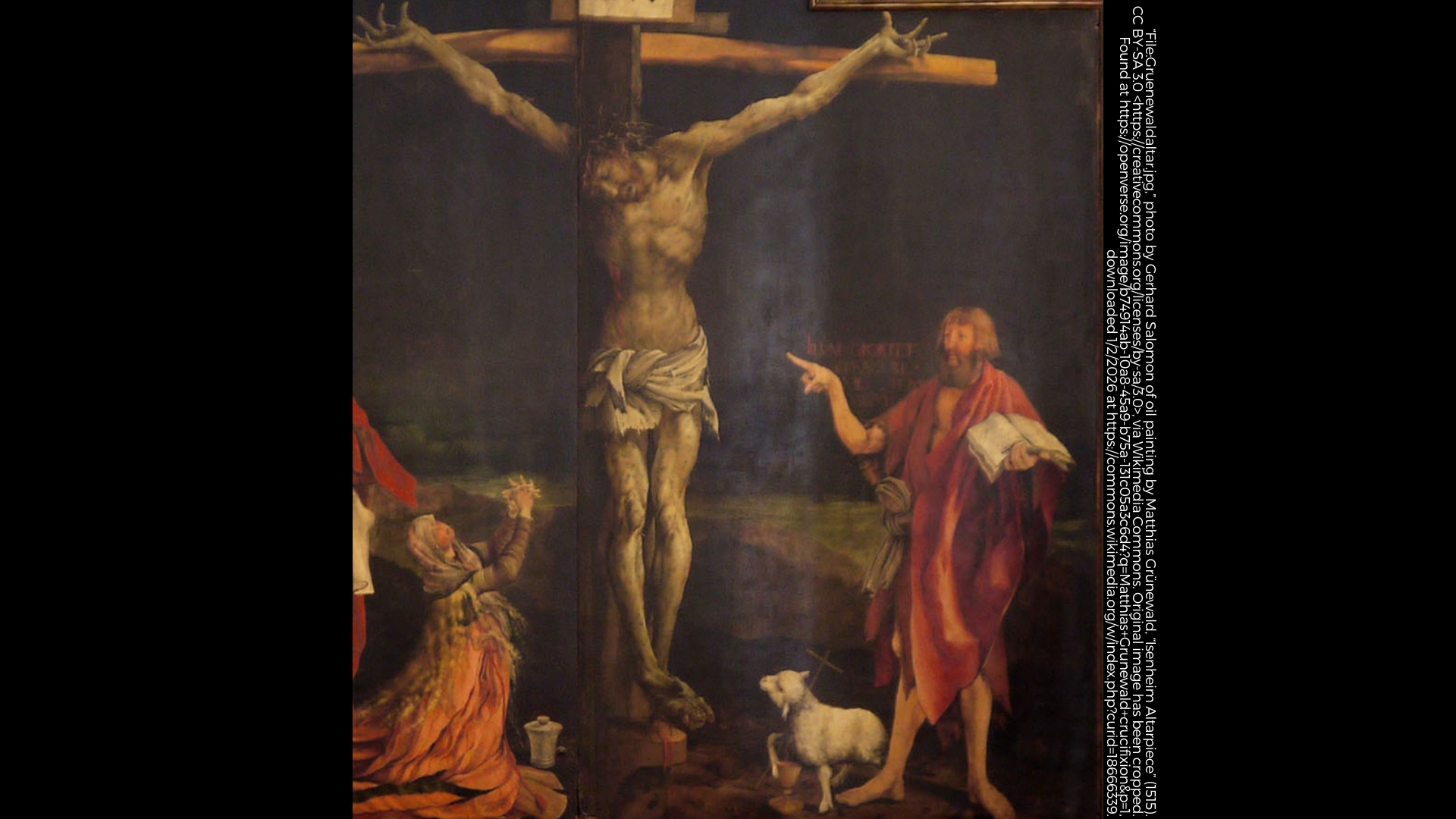
But perhaps my favorite Karl Barth story centers on this painting, which we put on the front of the bulletin. You might have wondered why this picture of the crucifixion was on the front cover of the bulletin? Why would we jump from the story of the birth of Jesus to his death? This was the painting that Karl Barth admired and kept in his office: Crucifixion by Matthias Grünewald. And what drew Barth to this painting is not just the striking image of Jesus on the cross, but the guy on the right side, holding a Bible. You may have figured out by now who that guy is: John the Baptist. Of course, if you know the story of the Gospels, you know that he was beheaded by the time that Jesus was crucified, but don’t take the painting too literally. The aim of the painting is to symbolically show what John was on earth to do…point. Karl Barth, as he entered his spiritual study each day, saw that picture, and for him it was a reminder of what his job on earth was. What every Christian’s job on earth is. To point. Barth’s attributed quote was this: “I want to be that finger.”
John the Baptist knew that his job was to point, not to himself, or his own work, but to seek out and point out the work of Jesus on earth. On the cross. As we begin the year today, many of us are feeling oppressed and alone in what feels like a pretty dark reality. And so, I am going to suggest a practical idea. When you read the news and feel overwhelmed. Or maybe even look at your calendar or your to-do list and feel overwhelmed. I want you to ask yourself two questions, reversing your functional atheism:
- Where is God already at work in this?
- How can you point to that work?
Author Frederick Buechner suggests this same way to live, writing, “A Christian is one who points at Christ and says, ‘I can’t prove a thing, but there’s something about his eyes and his voice. There’s something about the way he carries he head, his hands, the way he carries his cross—the way he carries me.’”
Occasionally, on one of those cave tours, the guide would stop us again, on the way back out of the cave. They would ask us to turn out our lights again, and we would be again plunged into darkness. But this time, after a minute or two, we would start to see that we were not in complete darkness. There was light coming from somewhere. We could barely make out the light in the distance. Then, someone would point, and proclaim, “There is the light! That’s is the way out!”
This year, as we wonder how long the darkness will surround us, may we remember that the light is there for us to see. And we are there to point it out to a world deeply in need of seeing it.
Leave a Reply