Scripture: Acts 2:1–11
We welcome American Baptist International Ministries global servant Christy Lafferty as our guest preacher this morning on Pentecost Sunday. Christy works with AMOS Health and Hope (AMOS stands for “A Ministry of Sharing”), an organization that cares for medical needs in urban and rural Nicaragua.
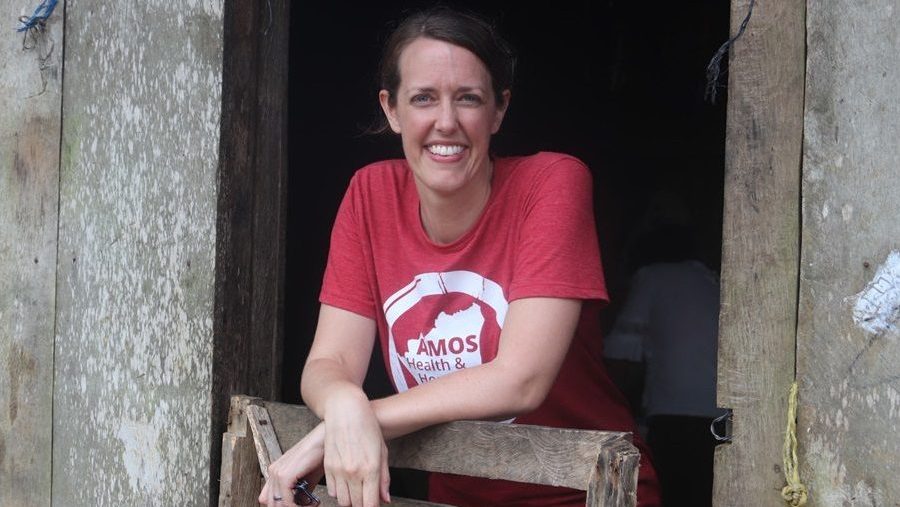
Christy has been serving God and her brothers and sisters in Nicaragua since 2012 as a part of AMOS Health and Hope. AMOS uses an empowering approach, following Christ’s example of listening to and healing the most vulnerable. They engage communities as full partners by training local leaders as community health volunteers. Their programs provide preventive and curative health services primarily to rural communities facing significant barriers to healthcare. Christy helps facilitate short-term mission opportunities and engages churches as partners in long-term ministry. She also completed a Masters in Theological Studies (MTS) in Latino/a Ministries through Palmer Theological Seminary and now serves as a student liaison for the program. Christy lives in Managua, Nicaragua, with her husband Abel and their son AJ.
Good morning, church! Thank you for having me here once again and for all the ways that you support me and the ministry of AMOS. I feel at home here and I hope when team members come to Nicaragua, that we make you all feel at home there too. I’m honored to be invited to share and reflect with you on such a meaning-filled day in the life of our faith.
When I think about pivotal moments, transformational moments in my life, in history, or in the lives of others, my mind often ponders about the BEFORE, the DURING, and the AFTER.
Pentecost was and is a transformative and pivotal moment in the life of the Church. As we just heard in Acts 2, this is the moment that God chose to send the Holy Spirit to fill the apostles and perform a miracle that would begin their public ministry to share the Gospel of Christ with the world.
I’ve heard this story many times and as someone who is fascinated by and loves to learn about the diversity of human language, culture, and communication—I have always been struck with awe at how the disciples of Jesus suddenly were given the gift to speak in another tongue and share the Gospel with a group of people they otherwise would not have been able to communicate with!
Pentecost evokes emotions for me of intense joy, a desire to worship God for the gift of the Holy Spirit, and a heart filled with wonder, but I can also relate to the possible confusion or fear that was in the air as the followers of Jesus and all the pilgrims gathered in Jerusalem for the festival of Pentecost on that day.
This morning, I’d like to reflect with you about the significance of Pentecost for us as Christians now, and more specifically, “How do we prepare ourselves to receive the Holy Spirit?”—not just on this day, but each and every day as we walk with Christ on our journey of faith.
So going back to thinking about the BEFORE, DURING and AFTER a pivotal moment, what was going on BEFORE Pentecost for the disciples that gives this day a much deeper meaning?
There is the historical context for sure—Pentecost was celebrated by the Jews as the holiday of Shavuot—in English, some translate this as the Feast of Weeks, the Feast of the Harvest, or the Feast of Firstfruits. It takes place exactly 50 days after Passover and marks a remembrance of God giving the Law to the people of Israel through Moses on Mt. Sinai.
It was not an accident that the Holy Spirit came on THIS day to Jesus’ followers! Here we might remember what Jesus expressed in Matthew 5:17—“Do not think that I have come to abolish the Law or the Prophets; I have not come to abolish them but to fulfill them.”
And so we can see the incredible depth of meaning that this day had for the Jewish people but let’s pause for a moment, because in Acts 2, we also need to remember what the disciples of Jesus had just experienced in Acts 1 and in their walk with Jesus before that!
During his life on earth, Jesus called his disciples to follow him, to leave their homes, to listen to his teachings, to learn from his example as he ministered to the poor, to the sick, and to the outcasts of society, to learn to pray and be in relationship with God Abba, Father. While he was alive, even though Jesus told his disciples many times that he had to die on the cross to save the world from sin and that He would rise again to redeem all Creation…they did not understand all that these events would mean.
After Jesus was resurrected, we learn that the disciples received another special gift—40 days of teaching from the Risen Christ about the Kingdom of God! I can also imagine that during this special time the disciples had with Jesus, they also spent time in prayer and fellowship. And yet I bet it still did not feel like enough. In between when Jesus finally ascended to heaven and the Pentecost, there were 10 days of waiting, of wondering, and probably even some worrying.
“How can we do this without our Lord?”
One day this week in preparation for Pentacost, I was listening to a daily devotional on the wonderful app called Lectio 365. The leader of this particular devotional focused in and made this BEFORE time that the disciples were living through so relatable to me:
“There is a false idea that as a faith-filled believer I should never feel overwhelmed. Psalm 40 says otherwise. So do the lives of Jesus’ disciples. They had gone through an incredibly disorienting time, experiencing in two short months:
The high of the triumphal entry.
The shock of Jesus’ arrest.
The low of abandoning him.
The pain of seeing him crucified.
The dizzying joy of his resurrection.
The processing of their own guilt.
It had been a lot!
Did God make the disciples wait between Ascension and Pentecost to give them space to process their emotions? Did they need to stop and reflect before they could move forward? Because I know I sometimes do.”
I can think of several different times in my life when I have felt overwhelmed. Overwhelmed by the stress of completing all the tasks I needed to do at work and well enough that this wonderful ministry I care so deeply about might be able to get a new grant or fundraise enough for a new project. Overwhelmed by changing rules, laws, and expectations for our organization. Overwhelmed by so many changes in the world at an unexpectedly fast rate and with so many consequences that we don’t know what our reality might be in the next few months, years, or decades.
Here is where the Holy Spirit can come in—if we let it. We must take the time to pause. To breathe. To pray—letting ourselves express all the intense emotions we might be feeling TO God, letting His peace that surpasses all understanding wash over us.
We are reminded of the goodness of God through the words of Jesus in John 14:15–27—We are never alone. Christ is always with us through the gift of the Holy Spirit!
Jesus said: “If you love me, you will keep my commandments. And I will ask the Father, and he will give you another Helper, [or Advocate] to be with you forever, even the Spirit of truth, whom the world cannot receive, because it neither sees him nor knows him. You know him, for he dwells with you and will be in you.
“I will not leave you as orphans; I will come to you. Yet a little while and the world will see me no more, but you will see me. Because I live, you also will live. In that day you will know that I am in my Father, and you in me, and I in you.”
The disciples were given a big PUSH on Pentacost. On their own, they may not have felt ready yet to publicly go out and preach the gospels to the people of many different cultures living in the Roman Empire at the time. But God prepared them for this moment for years. They had already given their lives and hearts to following Christ.
With a gust of powerful wind, God’s presence rushed into the room they were in. They were filled with the Holy Spirit—the Helper who Jesus had promised would come was right there with them.
In this moment, DURING the miracle of Pentecost, we do not read any reaction from the disciples themselves. They were being guided, led, and empowered by the Holy Spirit to speak and share the Gospel in new languages so that all the Jewish pilgrims there nearby would have a chance to be a witness to this miracle and be invited to follow Christ.
Theology professor and scholar, Eric D. Barreto, writes in a reflection on the miracle and meaning of Pentecost that: “God, through the Spirit, chose to meet us where we are: in the midst of a multitude of languages and experiences. The Spirit translates the gospel instantly into myriad languages.…God meets us in the messiness of different languages and does not ask us to speak God’s language. Instead, God chooses to speak our many languages. God does not speak in a divine language beyond our comprehension. At Pentecost, God speaks in Aramaic and in Greek and other ancient languages. And today, God continues to speak in Spanish and Greek and Hindi and Chinese alike. At Pentecost, God makes God’s choice clear. God joins us in the midst of the messiness and the difficulties of speaking different languages, eating different foods, and living in different cultures, and that is good news.”
Once the flames have rested about the disciples’ heads and they begin to speak in languages previously unknown to them, very quickly, we read that seeds of doubt were being sown and expressed by people in the crowd: “What does this mean? Oh, some of these men from Galilee have just had too much wine to drink.”
In any pivotal and transformational moment, things may happen to us or be changed around us, but we always have a choice of how we will react. Sometimes, what may have happened in our lives is so devastating that we might feel like we don’t have a choice, and yet, it is there. It might take time (sometimes a good amount of time). It might mean we need space or help to process what we have been through. But the Holy Spirit can be a life-saving companion to lift us up and give us new life.
I want to share a brief story that I heard recently, a little over a week ago. As I drove south on the 5 highway in Washington State towards Seattle, I decided to listen to a podcast of Simon Sinek called “A Bit of Optimism.” He is one of my favorite modern thinkers and someone you might have seen give a Ted Talk called, “Start with Why.” He is an excellent interviewer and in this recent episode, Simon was interviewing Tom Nash, an Australian man who, at age 19, suddenly fell ill with a deadly bacterial infection (meningococcal disease) that almost cost him his life.
During the many weeks that Tom was in the hospital, he had to have many surgeries to try to save his body from this devastating infection. He was given a 2% chance of surviving. He was put into an induced coma, he had to have plastic surgery on his face and neck and they had to amputate his legs. Then one day, his doctor came into his hospital room after his legs had been amputated and his doctor said this to Tom: “So we’re going to talk about your arms. As I see it, you have 2 options. We can amputate your arms. That’s the first option and it’s pretty rare for people to live with two prosthetic arms, but it does happen.” Tom had played the guitar and music was a core part of his identity. He really didn’t want to lose his arms. So he told his doctor, “I don’t really like the sound of that. What’s the other option?” And his doctor said, “Well we can leave them.” Tom replied, “Ok, well what’s the catch?” And his doctor (who Tom mentions really understood his naturally dark sense of humour), says to him, “Oh, well you’ll die.”
After Tom had a chuckle, he realized that for the first time he was being given an incredible gift by his doctor—he was being given a choice. Until that point, everything had happened to him. This small, but significant framing of this moment as a choice for Tom, completely changed his entire mindset from that point on in his life. He made this choice for his own life. And his journey to recovery and healing and how he approached his life after his illness—though not immediately easy, helped him to understand that he was not a victim, but a person with a chance to make choices about what he would now do with the gift of life.
Though it isn’t in our reading from today, I encourage you to read on in Acts chapter 2. After the Holy Spirit fills the disciples and God’s presence allows them to speak in new tongues, they are questioned. They are accused of being drunk! There is a choice in this moment that is critical—and it is Peter who is moved by the Holy Spirit, stands up and speaks loudly to the crowd of Jewish pilgrims who have gathered. He preaches! He shares from the Hebrew scriptures and shares about who Peter knows Jesus to be. The Holy Spirit has empowered him to make a bold decision and a bold invitation to the people in the crowd to repent and be baptized that day. In Acts 2:41, we learn that 3,000 people were baptized and that a new type of community of believers in Christ began to form and grow.
How do you and I prepare ourselves and our hearts to recognize the movement of the Holy Spirit in our lives? If we already believe in God and have already professed our faith as followers of Christ, we are part way there to allow the Holy Spirit to fill us, guide us, and empower us. Jesus promised that the Holy Spirit would be with us forever.
But many times, the busyness of our lives and the many distractions or stress and pain of this world can cause us to be influenced or led too much by things that are NOT the Holy Spirit. If I allow my worries or insecurities to drive my emotions, I sometimes have days where I feel lost or unsure what to do next. When the weight of the problems, injustice, and violence that is happening in the world, caused by humans, is overwhelming, I should immediately take the time to enter into prayer and offer up my emotions to God. But I admit that sometimes my prayers are too meek, too mild, and I start to block or avoid my heart from truly feeling the pain of what is happening to my brothers and sisters around the world, if the circumstances are not happening directly to me.
Today, on Pentecost Sunday, we live in this time AFTER the Holy Spirit was given as a gift to the church and all believers on Earth. But the presence of the Spirit of Christ in our lives is not a one-and-done kind of thing.
By taking a new and deeper look into the experience of the disciples in Acts 2, and recognizing all the ways that God was preparing them BEFORE Pentecost to receive such a powerful miracle that Christ had promised them, it motivates me both as an individual follower of Jesus and also, I hope that it motivates us all together as a community of believers to take time each day to prepare our hearts and minds for the Holy Spirit to fill us and constantly be shaped and transformed by God.
I am so grateful to God for the many ways and moments in my life that I have felt the presence of the Holy Spirit. There are several different names for the Holy Spirit, including: Advocate, Comforter, Intercessor, Strengthener, Counselor, and Helper.1 I know that God has shaped me for more than 15 years as I seek to serve Him in Nicaragua and has empowered me to use my gifts to support the work and ministry of others. But as I walk this journey, the Spirit of God has also helped me to learn (or re-learn) some very important lessons or qualities of the heart that help us to remain open to the movement of God’s Spirit.
Humility: In 2 Corinthians 12:9, Paul writes: “Each time [the Lord] said, “My grace is all you need. My power works best in weakness.” So now I am glad to boast about my weaknesses, so that the power of Christ can work through me. In the 14 years that I have worked with AMOS, over and over again I have witnessed the power of starting from a place of humility—I don’t know all the answers and if I listen, I will always learn something from the people around me, especially the people I hope to serve. When AMOS starts to work with a community or a group of people, we try our best not to make assumptions that we have all the knowledge or resources to share. Yes, we may have something that we can teach others, but if we are going to teach about first aid skills with local leaders, our staff starts by asking, “What are the traditions here in your community for how you clean a wound or try to bandage a cut?” When you can start to understand what knowledge or wisdom people already have—or what beliefs might help or hurt a community’s response to a health issue, you can more easily shape how you do a training and can honor them as people who have something to teach you too.
If we can train our egos to decrease and we can let the Spirit of Christ work through us, it is powerful to watch how we can share God’s love and how we communicate to people their worth and dignity. I am no better than anyone else on this earth. You have much to teach me. Let’s work together!
It might sound ALMOST the same, and I still need to work on it in my personal relationships, but there is a need to set aside our Pride: No human community is without conflict. So often, when you are in a conflict with someone or you feel that your point of view is not being taking into consideration, our Pride gets in the way.
Through AMOS, I have learned about restorative justice and restorative practices. When we work in a world of go, go, go and we put our heads down to work hard and get a task accomplish, sometimes our blinders go up. Our agenda becomes the most important and I don’t have time to look around and see what my coworkers’ or family member’s needs or tasks are at the same time. The Holy Spirit and the practice of prayer can really help our brains slow down.
Yes, sometimes we get hurt or offended by what someone said or did to us. Sometimes the offense was intentional, sometimes the person was not even aware of their mistake. When we can set aside our pride to talk to someone, to genuinely listen and try to understand someone else’s point of view, and let our Pride down so that we can forgive, the Holy Spirit will flow more easily.
Another lesson that I have learned is what God can do when we keep an open heart and mind to new experiences, new cultures, new perspectives, or new directions for your life or community. I can genuinely say that through my time serving with AMOS I have gotten to know and become friends with so many people—Nicaraguans and from all over the US—that I may have never gotten to know otherwise. I grew up in the suburb of a city in Ohio and I had a certain set of comforts and privileges growing up. Through my time with AMOS, I have been challenged. I have gone on long and muddy hikes alongside my Nicaraguan colleagues and mission team volunteers to install water filters. I’ve learned to use all manner of latrines or toilets. I’ve appreciated a bucket shower at 5:00 a.m. looking out at cows in a field as the sun rises.
When I felt a call on my heart from God to follow Christ and serve others through cross-cultural ministry, I never imagined where it would take me. But keeping an open heart and mind to the movement of the Spirit has given me more blessings and gifts than I could have ever imagined, even as I have been physically challenged or put in uncomfortable situations. I keep listening for God and the Spirit to guide me and lead me on the ever-changing path of life.
One final lesson I am still learning and asking the Spirit to guide me to live into is: Do not let a desire for or goal of perfection be an enemy of the good. I am the oldest of three kids in my family. My brain often cares too much about doing everything just right. I am a perfectionist, but that is not always a good thing! I am so grateful that God has shared wisdom through the words of co-workers who pointed out over years of working together that sometimes in my search for perfection, I can unintentionally offend a co-worker and communicate that I don’t trust their work when I double check a text or budget calculation just one last time. Yes, there are many times when being careful and having someone double-check your work is valuable (we all make mistakes!), but there is no such thing as perfection in human life. And if you have to be perfectly prepared before you can do something, you may never do it at all. God can use you before you are ready, just as he did the disciples on Pentecost.
A little over a year ago, one of my Nicaraguan co-workers and friends at AMOS asked me if I would be willing to start a prayer circle space once a week for the staff. Another missionary and I have been offering a time for prayer and being with God once a week. The spiritual practice of prayer (and exploring its many forms) along with meditation on Scripture in community has been a place where I have felt the presence of the Spirit. Sometimes it is a matter of slowing down, and inviting the Spirit in.
So as we move into the rest of our Sunday, as we remember the miracle of Pentecost that gave us the gift of the Holy Spirit in our lives, I invite you to join me in taking three deep breaths and asking that the Holy Spirit would fill this place and fill each one of us. Let us pray:
[three deep breaths]
Holy Spirit, breathe into me today what I might need. We are so thankful for your presence in our lives, though we may not always be fully ready or prepared for it. May we be filled, guided and empowered by you to follow Christ and share the Gospel—in word and in deed—with those around us. And God’s people say, “Amen.”
1 https://justbetweenus.org/everyday-faith/the-holy-spirit/they-call-him-holy-spirit/
Leave a Reply